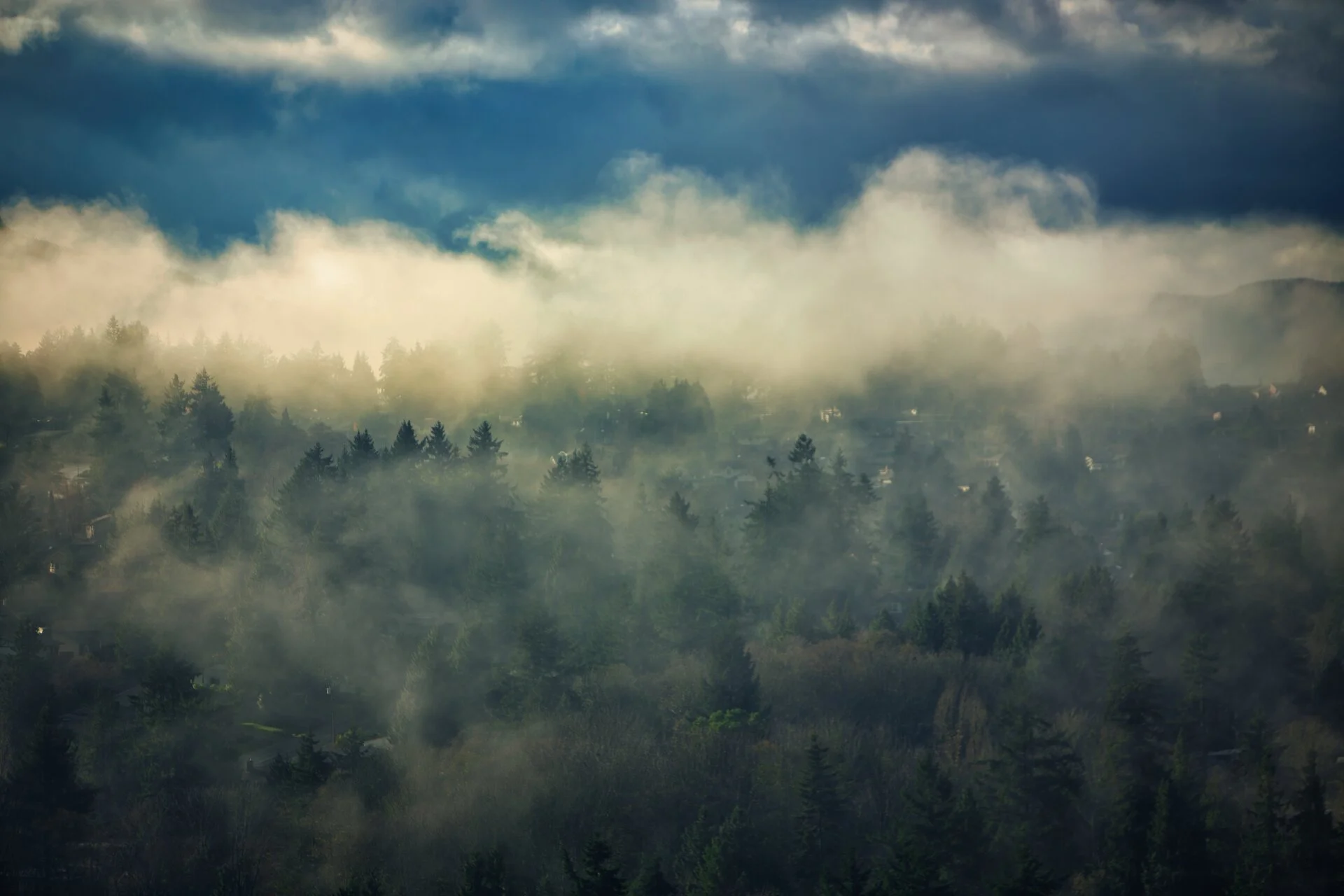
On Vancouver Island, the transition between the last breaths of winter and the first promises of spring creates an atmospheric phenomenon of rare intensity. It is a period of metamorphosis where the cold mountain air meets the rising humidity of an awakening ground. This guides explores the heart of the Pacific Northwest mist.

The Island's Awakening

This thermal shock envelops our cedar and Douglas fir forests in a thick, mysterious mantle of fog. For the photographer, this isn't just a weather change; it is the opening of a true visual paradise. Light no longer falls from the sky; it is suspended in the air, diffused by millions of micro-droplets. It is a time when the landscape loses its harsh winter edge to adopt an ethereal softness. Between Victoria and Tofino, every valley becomes a natural studio where depth of field is redefined by the fog. It is a season of blessing, a short interval where nature offers us its most intimate secrets, transforming the world into a living canvas where time seems to have stood still.
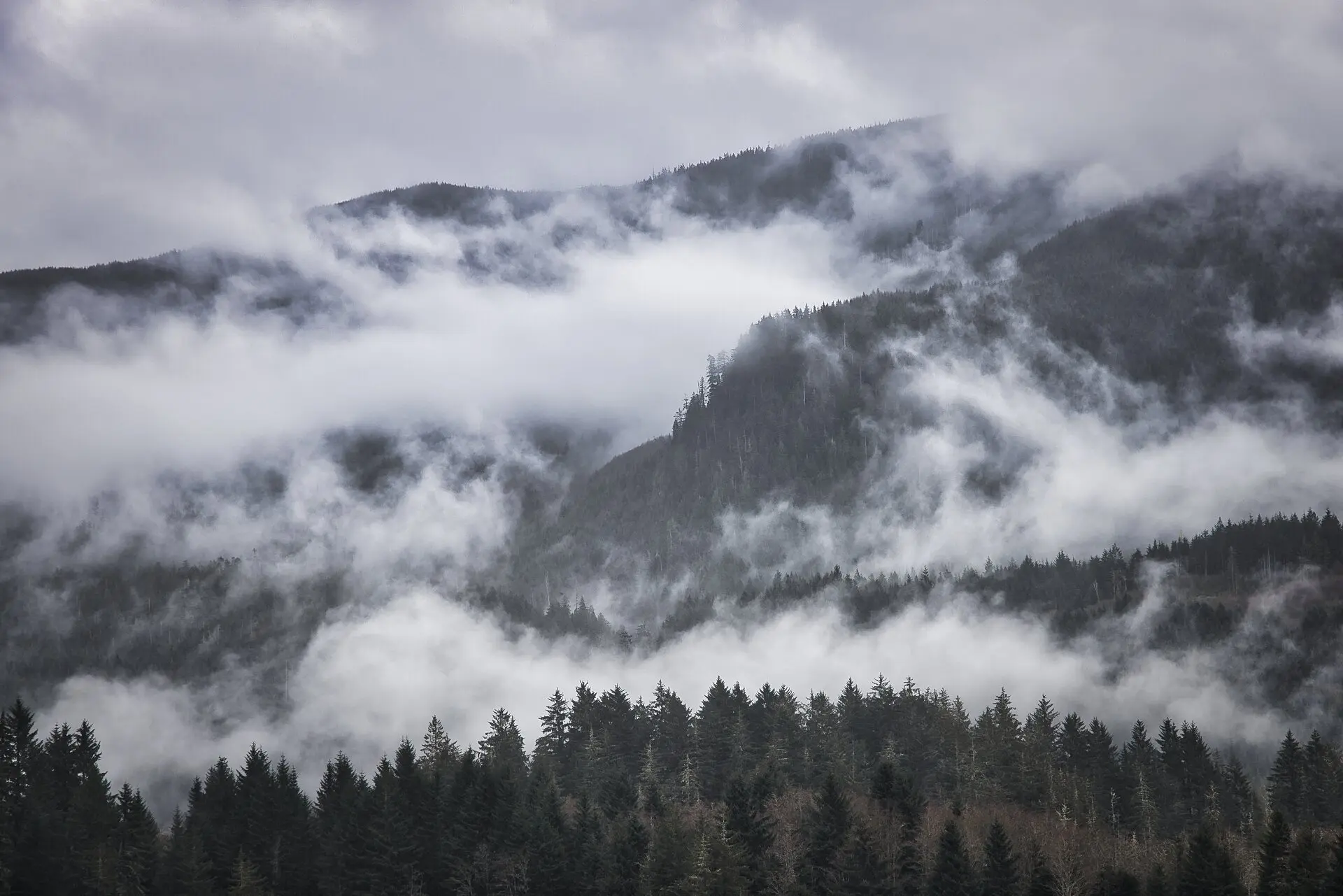
Moody Forest in Vancouver Island
The transition: Cold mountain air meeting the forest's breath.

The Minimalist Soul

Capturing the mist requires a total deconstruction of our usual reflexes. Here, the approach must be different: it is no longer about seeking absolute sharpness or loud detail, but learning to see what fades into the invisible. Photographing this passage between seasons requires being a bit of a minimalist at soul. One must seek a subject—a solitary tree, a fern silhouette, or a curving path—that agrees to vanish, to let itself be consumed by the whiteness. The void becomes as important as the form. Understanding this passage means accepting that the subject is not the center of the image, but rather an anchor in an ocean of uncertainty. The mist simplifies the forest’s chaos, eliminates distractions, and forces the eye to focus on the essential: a shape, a line, pure emotion. It is a poetic reading of the landscape where the less we see, the more we feel.

The Trap: The Mirage of Under-Exposure

One of the most frequent traps that a fog photographer encounters is chronic under-exposure. Your camera body, however advanced it may be, is programmed to interpret the world according to a neutral middle gray. Faced with the vast whiteness of a spring mist, the light meter "panics" and attempts to compensate for this brightness by darkening the image. The result is often disappointing: a grayish, dull, and dirty mist that loses all its dreamlike brilliance. Without manual intervention, your shots will lose that feeling of lightness and purity. It is crucial to understand that the camera sees light where it should see texture, and you must know how to contradict it to preserve the magic of the moment.

Misty Canopy Glow Illustration
Overcoming the Gray: Mastering exposure in the white void.

The Trick: Taming Over-Exposure

To do justice to the splendor of the mist, the golden rule is intentional over-exposure. Using your camera's exposure compensation, do not hesitate to push the slider between +0.7 and +2.0 EV. The goal is to force the camera to render white... as truly white. Watch your histogram: it should be pushed to the right, without "clipping" the highlights to the point of losing all detail. This precise setting restores the vaporous and luminous quality to your images. By over-exposing, you also increase the signal-to-noise ratio, which guarantees gray gradients of infinite softness, essential for rendering the subtle atmospheric transitions unique to the Island's forests.

Technique: The Balance of the Triangle

Technical management in misty environments relies on a delicate balance. For aperture, favor medium values (between f/5.6 and f/8); going beyond this risks making the mist too "textured" through diffraction, when we are seeking softness. Shutter speed must be closely monitored, because even if the mist seems static, it is in constant motion; a slightly longer exposure time can further smooth the atmosphere. Finally, keep your ISO at its lowest (50 or 100). Mist is unforgiving of digital noise, which breaks the purity of color blocks. Every setting must serve the clarity of the minimalist message you are trying to convey.
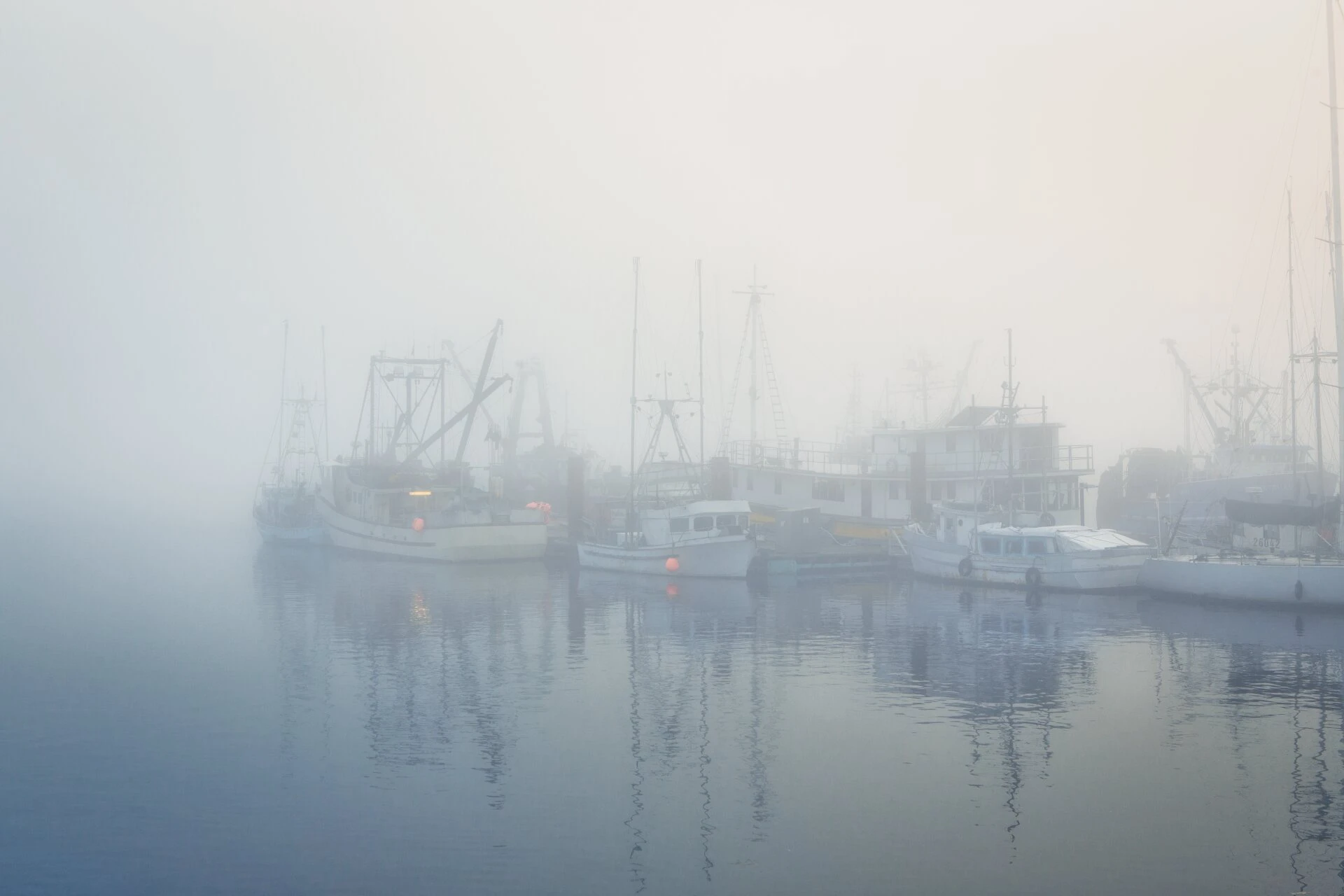
Misty Fishing Boats Coastline
Maritime Silence: Soft textures rendered through low ISO.

The Gift: Quality of Light

The advantages of this intermediate season are immense, the most precious being the unrivaled quality of light. The fog acts as a massive natural softbox, eliminating the harsh shadows and violent contrasts that often hide the forest's beauty. Under the mist, the colors of the emerging spring—the tender greens of moss and the rich brown of bark—saturate in an incredible way. Light becomes multidirectional, enveloping subjects in an almost divine aura. It is a light that flatters textures, reveals the subtle reliefs of nature, and allows for shooting all day long, without having to wait for the golden hour. It is a unique opportunity to capture the majestic forest in its most elegant and soft attire.

Observation: The Constant Movement

Mist photography is a school of patience. The fog is never frozen; it is in constant motion, sliding between trunks like a spirit, thickening one minute only to vanish the next. Staying and observing is the only way to succeed. Sometimes, all it takes is waiting for a gap of light to pierce the veil and create a striking contrast, or for a cloud of mist to isolate itself around a fir tree to create the perfect shot. Do not chase the image; let the mist come to you. Observe how it changes the perspective from second to second. It is in this contemplative waiting that one finally understands the rhythm of the Island and captures the moment when the forest truly becomes majestic.

Blessing: Between Simplicity and Majesty

Photographing this pivotal period between winter and spring is a true blessing. Nothing equals this season where nature seems to hesitate, offering a spectacle of fascinating duality. One constantly navigates between the extreme simplicity of erased landscapes and the infinite detail of a forest being reborn. It is a dialogue between the raw strength of ancient trees and the fragility of passing fog. In this atmosphere, every dewdrop on a branch becomes a diamond and every massive trunk a temple column. It is a celebration of the wild majesty of our coast, a moment where the photographer no longer just documents, but participates in a silent act of revelation.

The Call of the Hunt

The time has come to put away the excuses and pack your bag. The mist will not wait for you indefinitely; it is as ephemeral as it is essential. I encourage you, I even push you, to go out and start this peaceful hunt. Go breathe this air charged with moisture and spring promises. Do not fear the cold or the damp, for the visual rewards waiting at the end of a misty trail are incomparable. Go out, take in the air, let your lungs fill with the scent of wet woods and your eye be educated in subtlety. Nature is offering you its most beautiful magic show, and it is happening right here, on our Island. Go—the adventure begins at your doorstep, where the world vanishes into white only to better reveal itself to your lens.

Join a Landscape Workshop