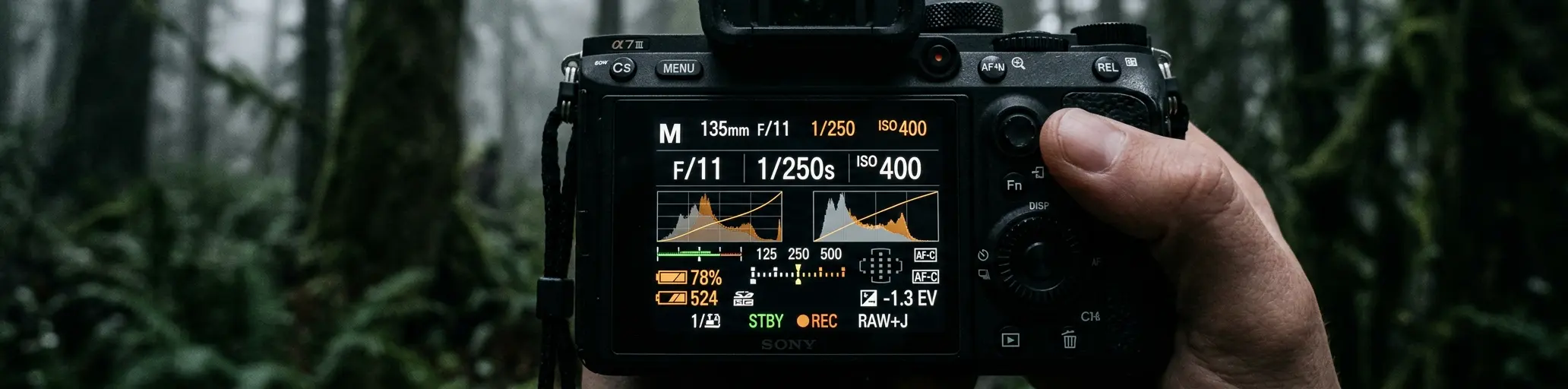
The Illusion of Manual Mode:
Why You Are Taught Backward
It is the single greatest lie in amateur photography education—a comforting, repetitive illusion. Instructors make people believe that Manual Mode is a magical formula, an unchangeable equation, or a cheat code that can be copied blindly from one environment to another: "If you are in the woods, just shoot at f/4, 1/250s, ISO 400."
The result? The moment the sun dips behind a heavy cloud layer on the coast, the moment a spotlight shifts color and intensity on a live performance stage, or the moment the dense fog of North Vancouver reshapes the reflectivity of the air, the photographer panics. They lose control because they memorized a static recipe instead of understanding the real physics of the kitchen. They apply abstract numbers without decoding the actual, living light.
Learning manual mode backward means seeking a sterile, mathematical "perfect" exposure dictated by an internal light meter. That meter is simply a blind algorithm programmed to calculate an average middle gray at 18%. It has no idea if you are capturing a bride in the snow or a piece of charcoal in a deep shadow.
The technical and artistic reality is far more challenging and liberating: Manual Mode is not a quest for arithmetic perfection; it is a permanent exercise in crisis management and a constant negotiation of trade-offs. Every decision you make to optimize one parameter alters, sacrifices, or redefines another aspect of your image. The digital sensor is a closed system where light energy is finite. If you open one valve to let the flow in, you must restrict another, fully accepting the physical and aesthetic side effects of that choice.
1. The Movement vs. Noise Compromise (Shutter Speed vs. ISO)
This dilemma manifests brutally in dynamic, low-light environments. Think of a smoke-filled, dimly lit stage during a live concert performance, or a raw portrait session deep within a temperate rainforest where wind relentlessly shakes the foliage and your subject's hair. The amateur notices a slight motion blur when zooming in on the LCD screen, and their mechanical reflex is to jump to a faster shutter speed.
- The Technical Choice: Increasing the speed from 1/60s (where human motion and micro-vibrations create a blurry trail) to 1/500s or 1/1000s to instantly freeze the action, the sweat of the musician, or the rustling wind.
- The Underlying Trade-off: By accelerating the curtain movement, you drastically slash the exposure duration. The temporal window allowing photons to hit the photodiodes snaps shut. You have blocked a massive amount of light energy. To compensate without changing your depth of field, you have only one choice: amplify the minimal electrical signal generated by the sensor. You must push the ISO.
- The Artistic Cost: You consciously trade motion blur for digital noise. Signal amplification (gain) does not create light; it magnifies background electronic interference. This introduces harsh luminance and color grain, crushes shadow details, and degrades color fidelity.
The Professional's View: The trade-off here becomes conceptual. Do you prefer a perfectly sharp photo textured by dense, organic grain, or a smooth, noise-free photo that is permanently ruined by blur? A professional will almost always choose digital noise. Grain tells a raw story, reminiscent of analog cinema film. Noise can be scupted and treated efficiently in post-production, whereas motion blur represents a permanent loss of data. Blur cannot be fixed; grain can be tamed.
2. The Space vs. Clarity Compromise (Aperture vs. Shutter Speed)
This is the grand battlefield of coastal landscape photography and environmental portraiture rooted in strict ethics. This is the precise moment you stand before a majestic view—like the ancient giant trees of British Columbia—and demand that every single texture, from the moss right in front of your lens to the mountain ridges miles away, holds absolute, razor-sharp piqué.
- The Technical Choice: Closing down the lens aperture to values like f/11, f/16, or f/22 to extend the geometric depth of field to its absolute limits, ensuring everything across all focal planes is critically sharp.
- The Underlying Trade-off: Your lens, which previously acted as a massive open window, is now restricted to the size of a pinhole. The photon flow hitting the sensor is reduced to a tiny trickle. If you refuse to raise the ISO to preserve maximum file cleanliness and avoid grain in delicate sky gradients, you have only one remaining lever: lengthen the exposure time by dropping your shutter speed.
- The Artistic Cost: You trade temporal stability for geometric depth. If you are shooting handheld without a heavy tripod to absorb your heartbeat, or if the landscape is moving (cedar boughs swaying in the storm, rushing waterfalls, moving clouds), your entire scene dissolves into motion blur.
Master Your Workflow
Struggling with Lightroom? I offer private 1-on-1 coaching to help you build an efficient, professional editing workflow, tailored to your style.
Inquire About Private Coaching3. The Purity vs. Artifact Compromise (ISO vs. Aperture)
We encounter this classic scenario in intimate, low-light situations—like a dramatic chiaroscuro portrait session under the dense canopy of North Vancouver's mountain valleys, or a twilight session on a rugged beach. The photographer watches the ambient light fade away entirely.
- The Technical Choice: The photographer demands the absolute, unadulterated purity of the sensor. They want smooth tonal transitions, flawless skin gradations, and deep, ink-like blacks completely free of compression artifacts, ensuring maximum file quality for large-format fine art prints. They lock the sensitivity to its lowest base value: ISO 100.
- The Underlying Trade-off: In the absence of light, if they refuse to drop the shutter speed below the safety threshold for handheld shooting, the photographer is forced to open the lens aperture to its mechanical limit (f/1.4, f/1.8, or f/2.8).
- The Artistic Cost: You trade focus tolerance for signal purity. At f/1.4, your depth of field shrinks dramatically down to a razor-thin zone of just a few millimeters.
The Portraitist's Discipline: At ultra-wide apertures, the margin for error is zero. If your subject breathes, shifts slightly, or if the autofocus points miss the pupil by a hair, the shot is lost. You get a perfectly sharp ear or nose tip, but completely soft eyes. Sensor purity at ISO 100 is worthless if the emotional heart of the portrait—the eyes—is out of focus. The mature compromise is to sacrifice absolute file purity, push to ISO 800 or 1600, and close down to f/4. You gain an optical safety net that guarantees the soul and expression of the face are critically sharp.
Why Most Photographers Block
Amateurs get discouraged and give up on manual mode because they approach it as a rigid, punishing math problem. They treat the exposure triangle like accounting, where the sole purpose of existence is to force the exposure meter needle to hit the exact center zero mark. By doing this, they remain slaves to the machine's internal computer.
A professional does not use manual mode for basic arithmetic; they use it as an exclusive staging tool for their artistic intention. Manual mode allows you to break the standard logic of the camera to impose your own interpretation of a scene—whether that means intentionally underexposing to create a heavy, dark mood, or overexposing to soften details.
The central question before a subject is never: "What are the right settings to expose this?" The real question, the one that separates simple execution from true artistic expression, is: "Which physical artifact of light and optics—digital noise, motion blur, or an ultra-shallow depth of field—am I ready to embrace, accept, and actively integrate into my frame to manifest the raw emotion I want to convey?"
Join the Collector's Circle
Get exclusive technical essays, behind-the-scenes workflows from North Vancouver, and priority access to limited-edition fine art print releases.