The Sky Replacement Debate:
Artistic Vision vs. Reality
By Joël Bourgoin | April 2026
Sky replacement in photography has become one of the most polarizing debates of our time, sparking a controversy as vivid as that of portrait retouching in the fashion industry. In the past, changing a sky required hours of meticulous work under an enlarger or in early versions of Photoshop. Today, thanks to Luminar Neo, Adobe Photoshop, or Lightroom, this transformation occurs in a single click, with minimal effort and technical knowledge. This democratization poses a fundamental question that divides the community: where does photography end and digital art begin? While the tool has become invisible, the author's responsibility has become immense. The debate is no longer about the technical ability to do it, but about the legitimacy of the act. When is it permissible to modify reality to serve a vision, and when do we cross the line into deception?
I. The Popularity of Sky Replacement
Sky replacement has gained unprecedented popularity because it solves the photographer's major problem: the unpredictability of nature. The impact on an image is immediate; a flat, dull sky can ruin a scene captured with deep emotion, while a dramatic sky transforms a simple view into a powerful artistic work. AI performs miracles here, managing complex masks around trees or structures with surgical precision, phenomenally accelerating processing and production time.
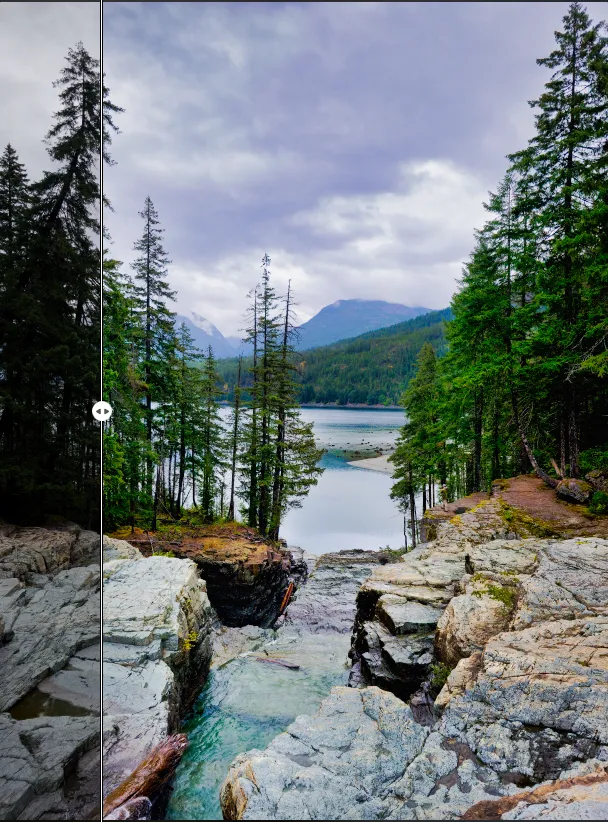
It is a tool that allows one to transcend the moment to reach an artistic dimension. For example, if I am photographing an ancient forest in the Cowichan Valley under a milky grey sky, I will choose to **keep my original sky**. Why? Because that greyness is part of the damp, authentic atmosphere of the place; it tells the truth of the forest. Conversely, for a commercial landscape portrait where the sky is completely white and "blown out," I will not hesitate to **replace it** with a subtle late-afternoon sky. Here, the change does not aim to lie, but to save a technically imperfect image to restore the emotion my eyes felt, even if the sensor failed to capture it.
II. The Frontiers of Retouching
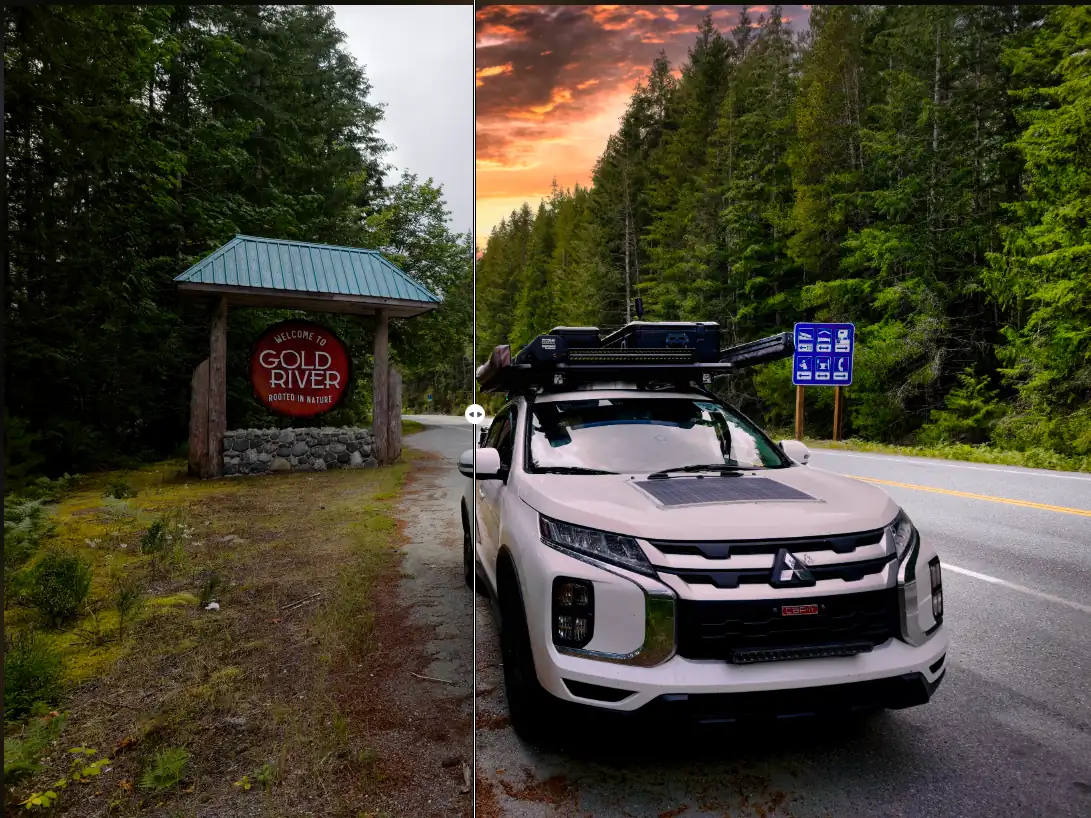
With nearly 20 years of experience behind the lens and in front of the screen, I have witnessed the evolution of these tools. I learned to master Photoshop, but I admit today that I often find it too long and complex for the needs of a modern workflow. What matters to me is not the complexity of the tool, but the result: staying within the limits of the real. It is vital not to push our artistic expression to the point of distorting the subject. Retouching should be like seasoning in cooking: it should enhance flavors, not mask them. My philosophy is to stay true to what I call "the art of the real." If the viewer guesses the retouching, then I have failed. Our frontier stops where the pixel begins to betray natural light. We must use AI to free ourselves from ungrateful tasks, but keep our hand on the slider of truth.
III. Laws and Ethics: The Real Estate Case
The question of sky replacement goes beyond the artistic framework to become a legal issue, particularly in the real estate sector. Several countries, such as France with the "Mannequin Law" (requiring the mention "retouched photograph" for bodies), are beginning to regulate imagery. In real estate, some countries severely punish "misleading advertising." In Canada, there is not yet a specific law prohibiting sky replacement in real estate, but realtor associations and the Competition Act regulate false representations. An over-retouched image can drastically influence your judgment. Imagine buying a property for its "spectacular" sunset view, only to realize on-site that the sky is perpetually grey due to a nearby factory masked by retouching. This is where you realize the scam: the photo is no longer an invitation, but a deceptive bait that breaks the trust between the professional and their public.
IV. Awareness in the Age of AI
Why is this debate so heated today? Because we are facing a brutal awareness of what AI can do. It can produce in seconds what a human took a career to refine. It is a new world, a time of necessary questioning and adaptation. The aspect of trust is at the heart of the problem. If everything can be modified without effort, what still has value? I firmly believe we must remain discreet. AI should be a servant, not the master. To maintain the link with my audience, I bet on transparency. The public accepts the artistic, but they dread hidden artifice. In this technological turmoil, visual honesty becomes a safe haven.
V. Finding the Middle Ground: The HDR Lesson
We must know how to find the right balance, and the history of photography teaches us patience. Remember the early days of HDR (High Dynamic Range): everything looked plastic, apocalyptic, almost radioactive. It was a novelty we used poorly, out of over-enthusiasm. Today, HDR is an invisible standard, present in every smartphone, every video, and every high-quality landscape photo. It took us years to adapt and learn to use it with subtlety. AI sky replacement follows the same path. We are currently in the "spectacular" phase, but we will move toward a more mature integration. The balance lies in the maturity of the gaze: knowing you can change everything, but choosing to modify only what is necessary.
Conclusion
Ultimately, the essential thing is to stay anchored in the real. What exceeds the real simply belongs to the domain of the artistic and must never be confused with a testimony of truth. The important thing is to take pleasure in retouching, as it is an extension of our creativity, but to remain ourselves. Let us be realistic photographers who use technology to sublime life, not to replace it. Because beyond the sky, it is our integrity that we expose to the light.